Digital Marketing · SEO
Is Your Business Showing Up in AI Search?
Google’s AI Overviews and tools like ChatGPT are changing how people find local businesses. Here’s what that actually means for small businesses in Surrey — and what to do about it.
A few years ago, “getting found on Google” meant one thing: ranking on page one. That’s no longer the whole picture. Increasingly, people don’t click through to a website at all — they ask Google’s AI Overview, or type the question straight into ChatGPT, and get an answer with a business recommendation baked right in. If your business isn’t part of that answer, you’re invisible in a search that never even reached your website.
This isn’t a distant, futuristic shift. It’s already changing how people search for a plumber, a coffee shop, or a digital marketing studio in Surrey, right now.
What’s actually changed
Search used to be a list of ten blue links you clicked through. Now, a growing share of searches end with an AI-generated answer at the very top of the page — summarising, comparing and recommending, often without the person ever scrolling down to the traditional results. Separately, more people are skipping search engines entirely and asking AI assistants directly: “what’s a good digital marketing agency in Farnham” typed straight into ChatGPT, expecting a real answer, not a list of links to go research themselves.
Marketers have started calling the discipline of optimising for this Generative Engine Optimisation (GEO) — a cousin of traditional SEO, but with a different goal: not just ranking, but being the business an AI system chooses to mention.
Why this matters more for local businesses, not less
It’s tempting to assume this is a big-brand problem. It’s actually the opposite. AI answers to local, specific questions — “best bakery near me,” “reliable plumber in Guildford” — draw heavily on the same signals that already matter for local SEO: your Google Business Profile, your reviews, and how consistently your business is described across the web. Small, local businesses that get these fundamentals right have a real shot at being the answer an AI gives, precisely because there’s less competition fighting over local, specific queries than broad national ones.
The businesses that show up in AI answers aren’t necessarily the biggest — they’re the ones an AI system can most confidently verify as real, relevant and trustworthy.
How AI systems actually decide who to recommend
AI tools aren’t guessing. They’re pulling from real signals, most of which are the same fundamentals good SEO has always cared about — just weighted differently:
- Structured data (schema markup) — code on your website that explicitly tells search engines and AI systems what your business is, where it’s located, and what it offers, rather than making them guess from paragraphs of text
- Consistent business information — your name, address and phone number matching exactly across your website, Google Business Profile, and any directory listings
- Genuine reviews — real, recent reviews are a strong trust signal AI systems weigh heavily when deciding who to recommend
- Clear, direct content — pages that plainly answer specific questions (“do you offer free quotes,” “what areas do you service”) are far easier for an AI to extract and cite than vague marketing copy
What we did on our own site
We didn’t just write about this — we built it into bigskydigitalmarketing.co.uk itself. Every page carries structured data identifying us as a local business, including our service area, pricing range and contact details in a format AI systems can read directly, not just infer. It’s a small technical step, but it’s exactly the kind of thing most small business websites skip.
What to actually do about it
None of this requires throwing out your existing marketing. It means paying attention to a few things that matter more now than they used to:
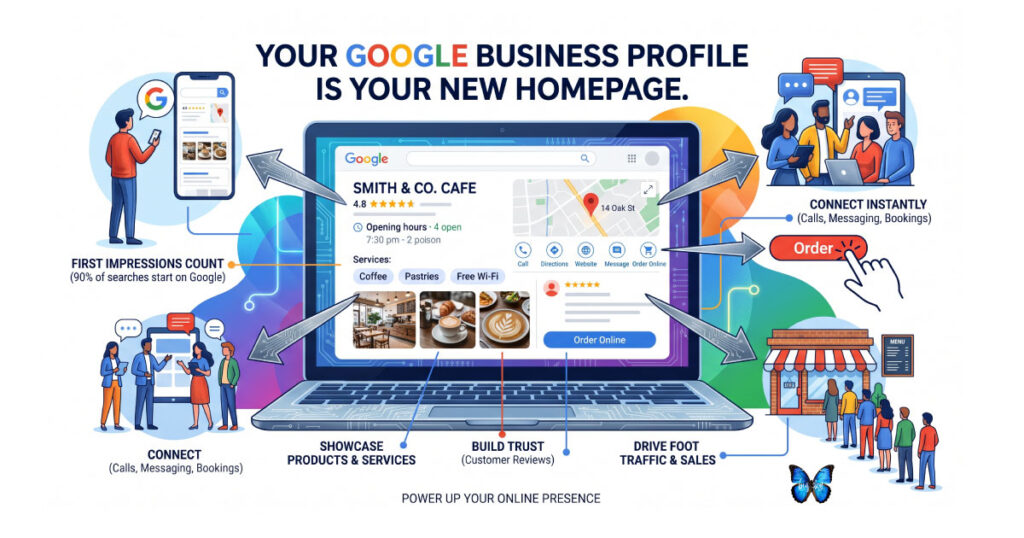
- Keep your Google Business Profile complete, accurate and active — hours, services, photos, and responses to reviews
- Actively (and honestly) ask happy customers for reviews, rather than hoping they show up on their own
- Make sure your business name, address and phone number are identical everywhere they appear online
- Write website content that plainly answers the exact questions customers ask, rather than vague brand language
- Add structured data (schema) to your website so AI systems can read your business details directly
What doesn’t work anymore
- Keyword stuffing — AI systems parse meaning, not keyword frequency, and over-stuffed pages read as lower quality, not higher relevance
- Fake or incentivised reviews — increasingly easy to detect, and a fast way to lose trust with both customers and AI systems
- Copying competitors’ content — AI tools cross-reference multiple sources; generic, duplicated content gives them nothing distinct to cite
The bigger picture
This isn’t a reason to panic, or to believe traditional SEO is dead — it isn’t. It’s a reason to make sure the fundamentals are genuinely solid, because the businesses winning in AI search right now are mostly the ones that were already doing local SEO properly. The gap is opening between businesses that treat their online presence as a real, maintained asset, and those that set up a website once and never touched it again.
Not sure if your business is AI-search ready?
Book a free 30-minute chat and we’ll check your Google Business Profile, reviews and website structure together — no obligation, no jargon.
Book your free chat