Digital Marketing · Branding
Your Brand Personality Is the One Thing AI Can’t Copy
We’ve written before about how AI content tends to sound the same. Brand personality is the actual answer to that problem — and it’s more measurable, and more valuable, than most Surrey small businesses realise.
We wrote recently about why AI-only content tends to converge toward the same generic middle ground. The flip side of that problem is genuinely good news: a clear, consistent brand personality is one of the few things a model can’t manufacture on its own — and it turns out to be worth real money, not just a nicer-sounding business.
That last figure matters as much as the first two. Consumer trust research consistently finds that most people need to trust a business before they’ll buy from it at all — and trust isn’t built through a single great post or a clever headline. It’s built through the same personality showing up, consistently, every single time someone encounters your business.
Brand personality isn’t your logo
This is the part most small businesses get wrong. A logo, a colour palette, a font — these are the visual expression of a brand personality, not the personality itself. The actual thing is simpler and harder at the same time: is your business warm or authoritative? Playful or precise? Does it sound the same in an Instagram caption as it does in a reply to a customer complaint? Most small businesses have never actually answered these questions, which is exactly why their content can drift and feel inconsistent, even before AI tools are involved at all.
Trust isn’t built through advertising claims anymore — it’s built through direct, repeated, consistent experience. Consistency is the actual mechanism behind almost every branding statistic worth paying attention to.
A simple way to actually define yours
You don’t need a branding agency or a 40-page brand guidelines document to get real clarity here. Answer these three questions honestly, and you already have the foundation:
Question 1
If your business were a person at a party, would they be the one cracking jokes, or the one quietly giving the best advice in the room?
Question 2
What are three words a genuinely happy customer would use to describe working with you?
Question 3
What would you never say, even if it might get more engagement?
A framework that makes this concrete: the 12 brand archetypes
If the three questions above feel too open-ended, marketers have used a more structured tool for decades: the 12 brand archetypes, adapted from Carl Jung’s work on universal character patterns. The idea is simple — every strong brand personality tends to map onto one dominant archetype, each tied to a core human motivation. Most small businesses fit clearly into one or two once they actually look at the list.
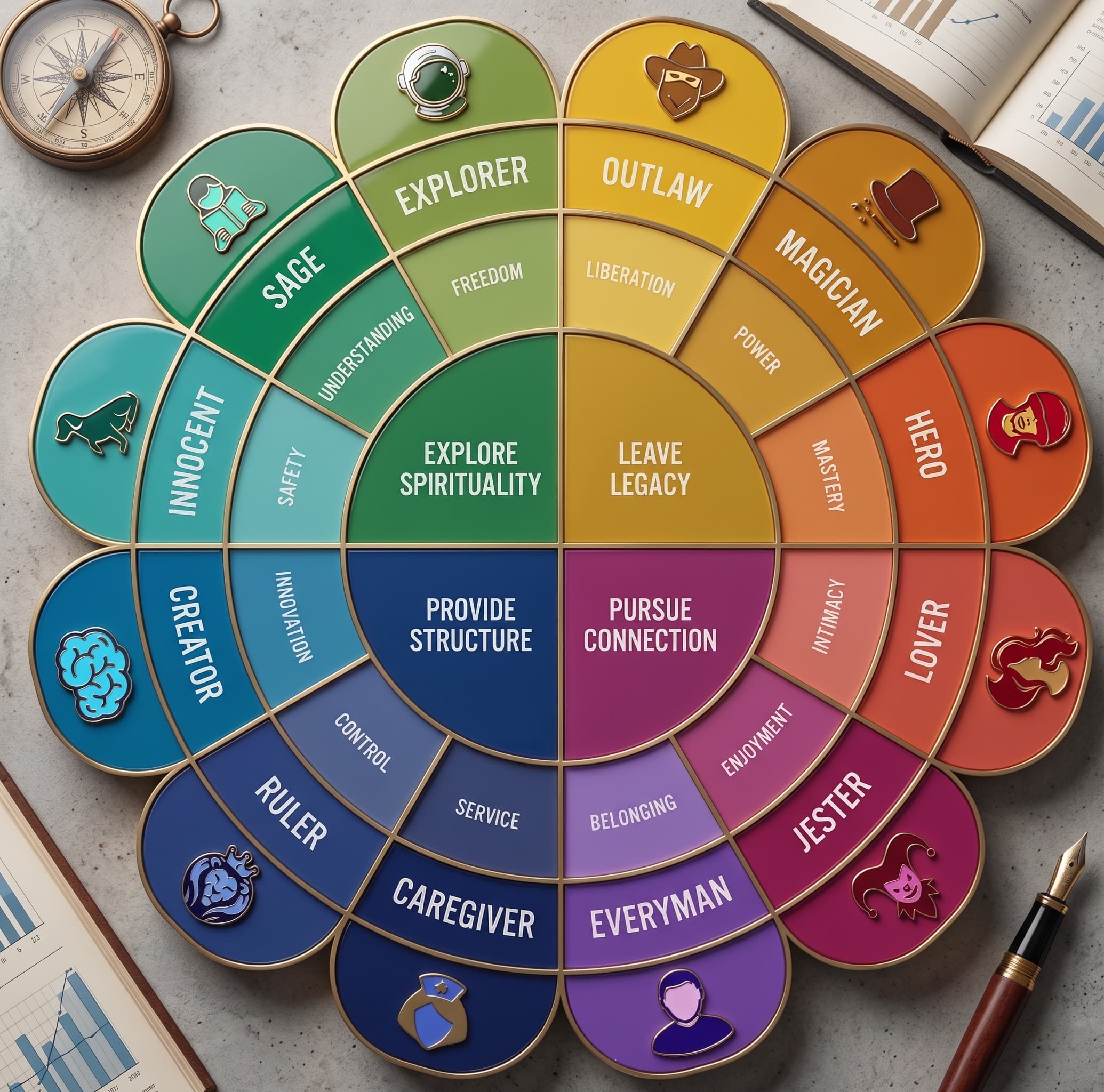
The 12 brand archetypes, grouped by the human motivation each one taps into.
Motivation: Provide Structure
- Ruler — leads with authority, confidence and control
- Caregiver — nurtures and protects, puts others first
- Creator — values originality, craft and self-expression
Motivation: Pursue Connection
- Everyman — relatable, down-to-earth, values belonging
- Jester — playful, fun, doesn’t take itself too seriously
- Lover — warm, intimate, focused on relationships
Motivation: Leave a Legacy
- Hero — proves worth through skill, courage and results
- Outlaw — challenges convention, values honesty over polish
- Magician — transformative, makes the difficult look effortless
Motivation: Independence & Fulfilment
- Sage — shares knowledge, values truth and expertise
- Innocent — honest, optimistic, keeps things simple
- Explorer — independent, adventurous, resists convention
A family-run bakery is often, instinctively, a Caregiver or an Everyman. A bold local gym is frequently a Hero. A design studio pushing against convention might genuinely be an Outlaw. None of these are better than the others — the value is in picking one honestly and letting it show up consistently, rather than drifting between several depending on who wrote that day’s post.
Why this matters more now, not less
As more businesses lean on AI for content, the ones who stand out won’t be the ones avoiding AI — they’ll be the ones with a strong enough sense of their own personality that it survives being run through any tool at all. A consistent personality is what turns a stream of individual posts into something a customer actually recognises and trusts over time.
What actually breaks brand personality
- Switching tone dramatically between platforms — formal on the website, chaotic on Instagram, with no thread connecting them
- Copying a competitor’s voice because it performed well for them — it will read as hollow, because it isn’t actually true of your business
- Treating brand personality as a one-time exercise rather than something every piece of content gets checked against
The bigger picture
None of the tools we’ve written about on this blog — AI, short-form video, GEO, reviews — matter much if what they’re amplifying doesn’t actually sound like anything. Brand personality is the one input that makes everything else worth doing in the first place.
Not sure what your brand personality actually is yet?
Book a free 30-minute chat and we’ll help you find it — or build it from scratch if you’re starting fresh.
Book your free chat